
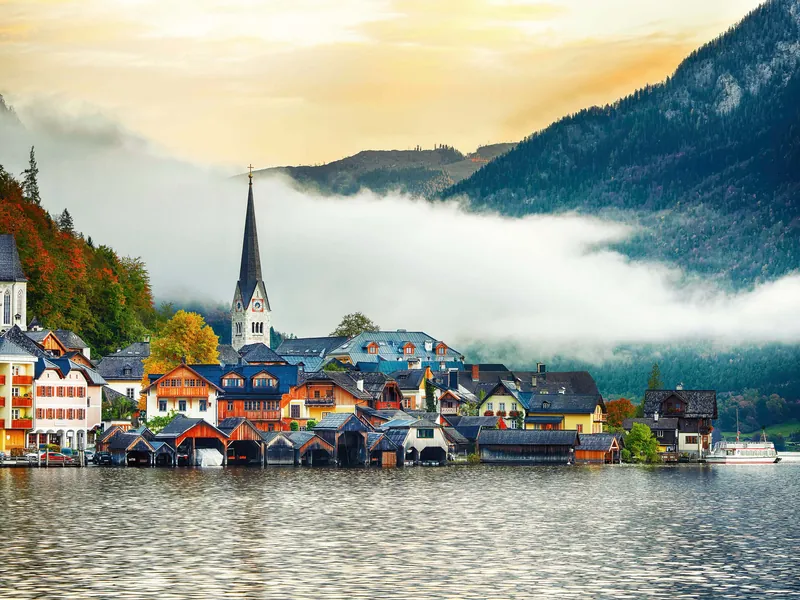
The classic view
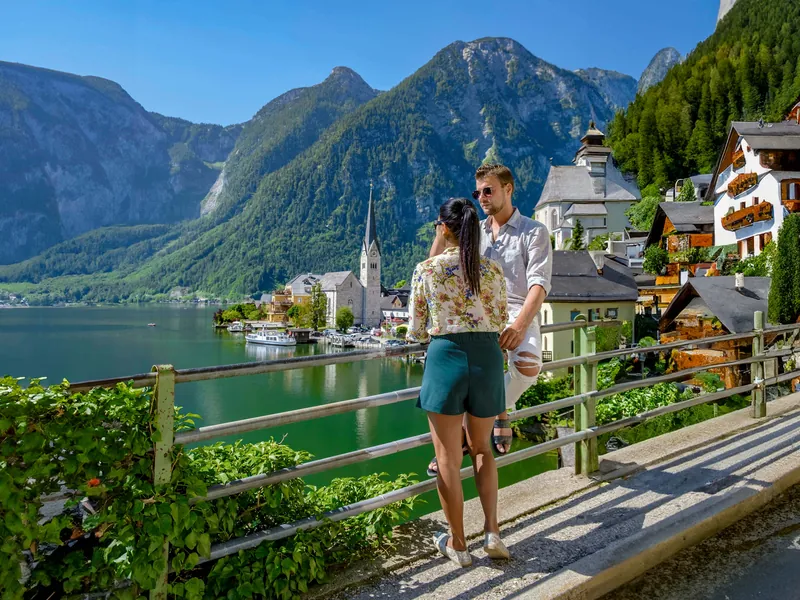
The postcard angle is from the northern end of the village, along Gosaumühlstraße. Come at first light and you will have it almost to yourself.
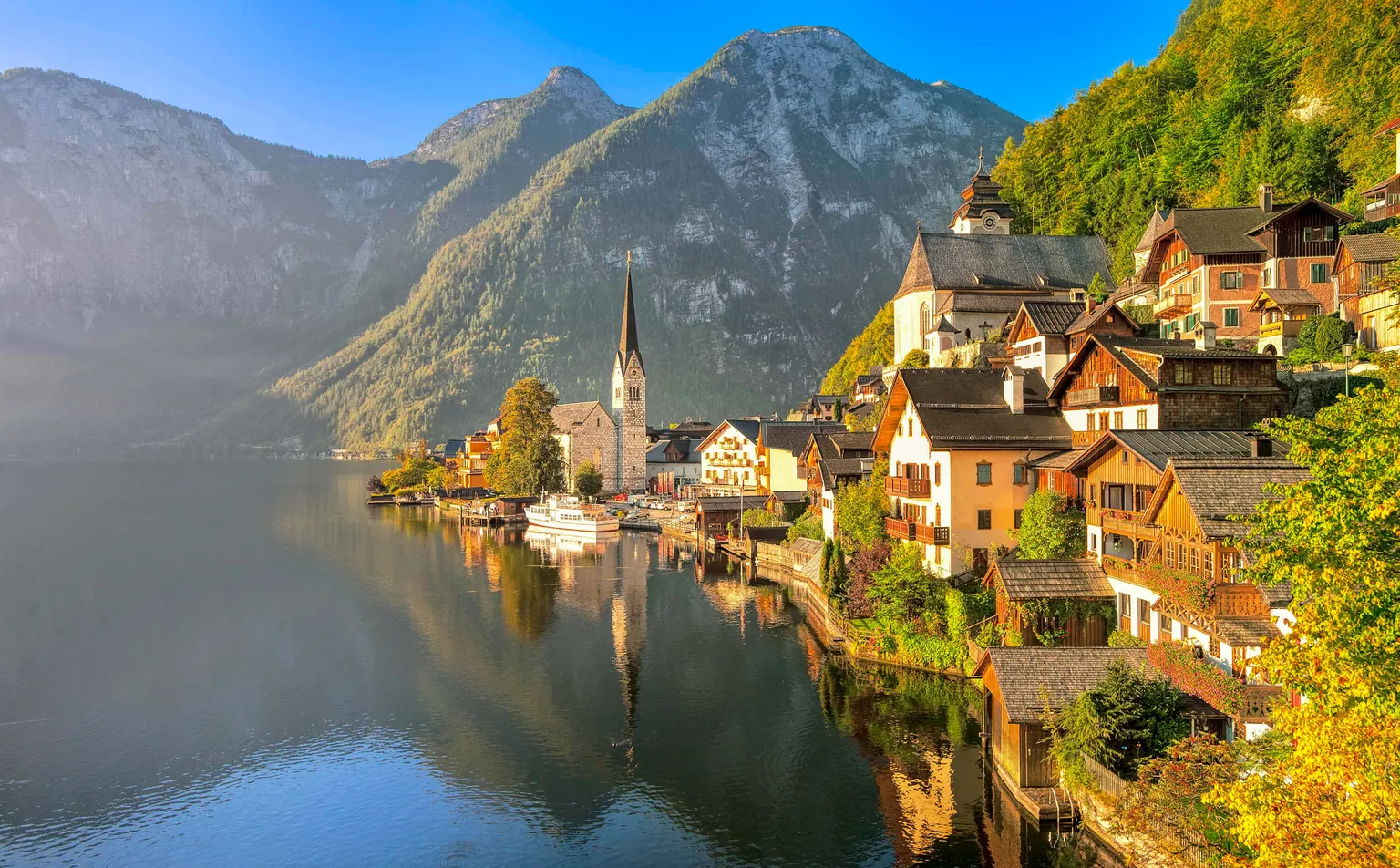
Around 750 people live here. Roughly 1.2 million visitors came through in 2025. There is a difference between seeing Hallstatt and queueing for a photo of it. This guide is about that difference — what to visit, when to arrive, and how to walk the village with the stories switched on.
This is the opening of the Hallstatt walking tour, narrated by Stefan — a miner who, as he freely admits, is not quite your contemporary. Press play.
English preview. The full tour is available in the app in your language.
A self-guided walk from the Lahn ferry pier to the World Heritage viewpoint. A little over one kilometre, 17 stops, an hour and a half if you don’t stop for cake. You follow the route on a map in the TouringBee app. The audio plays as you go — offline, at your pace.
It takes in the Ossuary, Market Square, the Holy Trinity column and both churches. It also takes in the parts of Hallstatt that carry no signpost. Why the houses are stacked on top of each other. What the women carried down the mountain twice a day. And what happened here in 1846 that gave an entire European age its name.
See the full tour detailsEntry tickets to the Ossuary, salt mine and museum are not included.
Hallstatt is famous for a photograph. It deserves to be famous for something else entirely — it is the reason an entire period of European prehistory is called the Hallstatt culture.
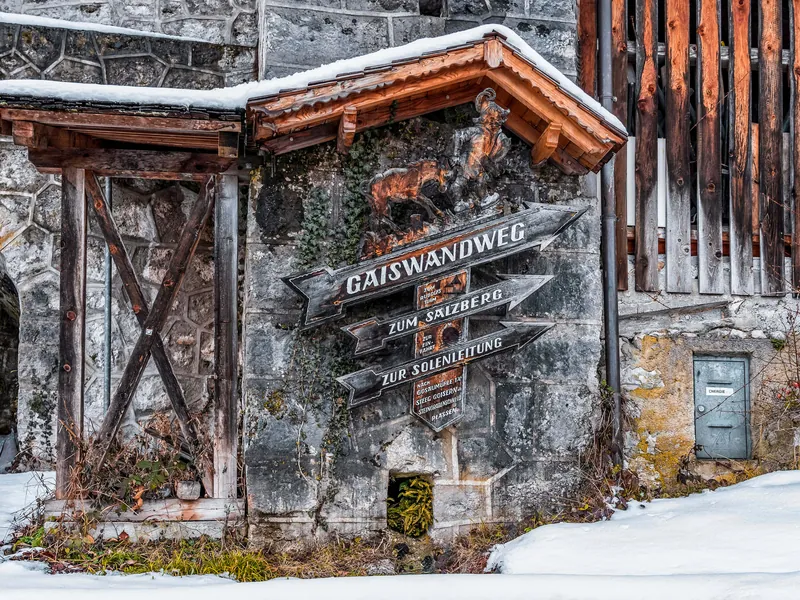
People were digging for salt in this mountain before Stonehenge was raised. A deer-antler pick from the mine dates to around 5000 BC. Excavations by Vienna’s Natural History Museum push the earliest traces back roughly 7,500 years. Systematic underground mining ran from about 1500 BC until a debris flow closed the workings around 1245 BC.
Salt also explains the name. Hall is the old word for salt; Hallstatt is, quite literally, the salt place. And salt is why so much survived: it preserves wood, leather, textiles and rope. In 2002 miners uncovered a wooden staircase inside the mountain dated by its tree rings to 1344 BC — the oldest wooden staircase in Europe.
In 1846 the mine master Johann Georg Ramsauer put a spade into the slope above the village. He found a prehistoric cemetery, and he kept going until 1863. 980 graves. 19,497 objects — swords with ivory hilts, glass beads, bronze work. He recorded all of it in lists and watercolours, at a time when nobody excavated that carefully.
In 1874 the Swedish prehistorian Hans Hildebrand gave the Early Iron Age of central Europe a name borrowed from this village. The Hallstatt period, roughly 800–450 BC, stretches from north-eastern France to the north-western Balkans. Excavation here never really stopped; the Natural History Museum has been digging continuously since the 1960s.
Until the late 19th century there was no road worth the name. You arrived over the mountains, or across the water. That is why the railway, opened in 1877, runs along the far shore. Passengers have been finishing the journey by ferry ever since — still the best way to arrive.
The Habsburgs took the salt trade under control early. Market rights in 1311. A coat of arms from Maximilian I in 1494. Then, between 1595 and 1607, a wooden brine pipeline over the mountains to Ebensee — roughly 40 km of it. It still carries brine today, and is generally called the oldest industrial pipeline in the world.
In 2012 a Chinese developer opened a full-scale replica of the village centre in Guangdong province. Around the same time a certain animated film about an ice queen appeared, and the internet decided Arendelle was Hallstatt. Disney’s artists have never said so — they went to Norway — but the resemblance was enough.
The result is a village of about 750 residents absorbing something like 1.2 million day visitors a year, against only ~132,000 overnight stays. Which is precisely why when you come matters more here than almost anywhere else in Austria.
Six things worth your time in a village you can cross in fifteen minutes.
The postcard angle is from the northern end of the village, along Gosaumühlstraße. Come at first light and you will have it almost to yourself.
The world’s oldest salt mine, with the underground slides, the Bronze Age gallery and the Skywalk platform above the village. Closed for rebuilding until 29 August 2026 — details below.
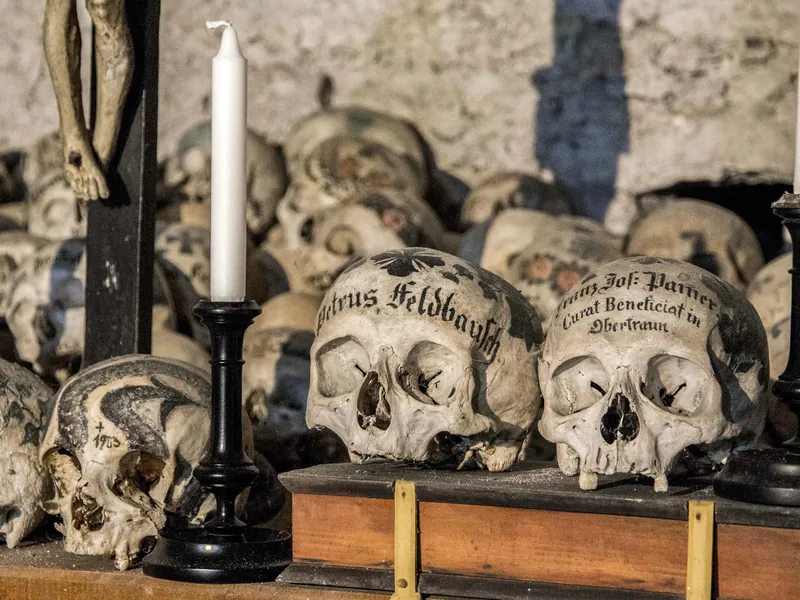
About 1,200 skulls in the chapel of St Michael, 610 of them hand-painted with names, dates and wreaths. Entry €2. The most recent arrival was placed in 1995.
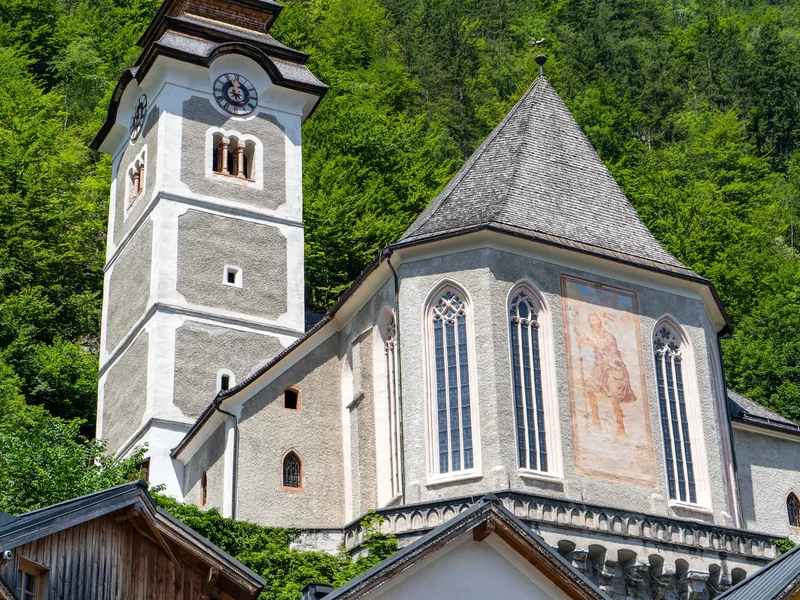
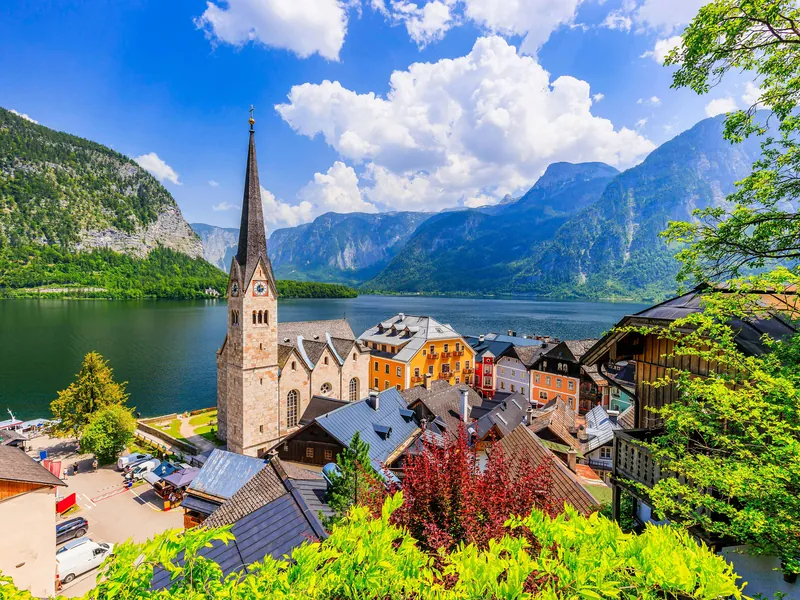
The slim spire in every photograph belongs to the Evangelical church. The Catholic parish church above it holds a 15th-century winged altar with its own crime story attached.
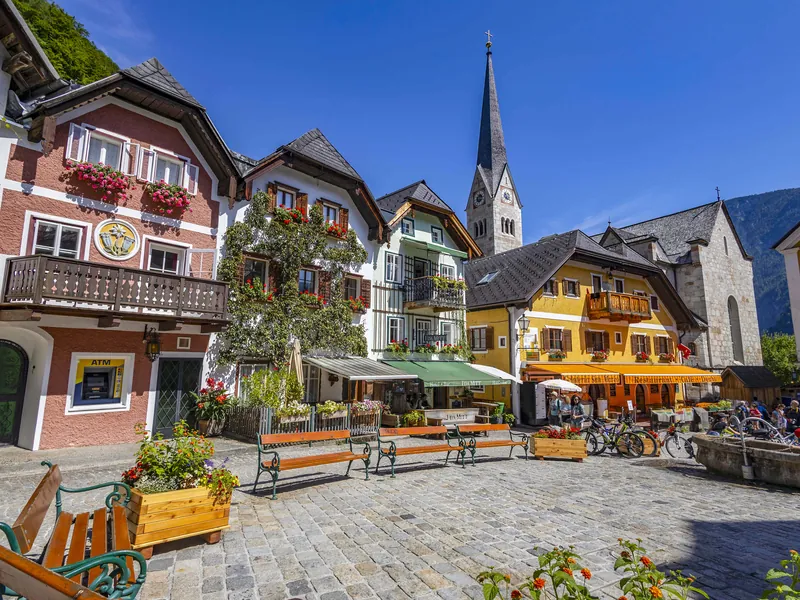
Rebuilt after the fire of 20 September 1750 that took some 35 buildings. The Holy Trinity column in the middle survived it untouched.
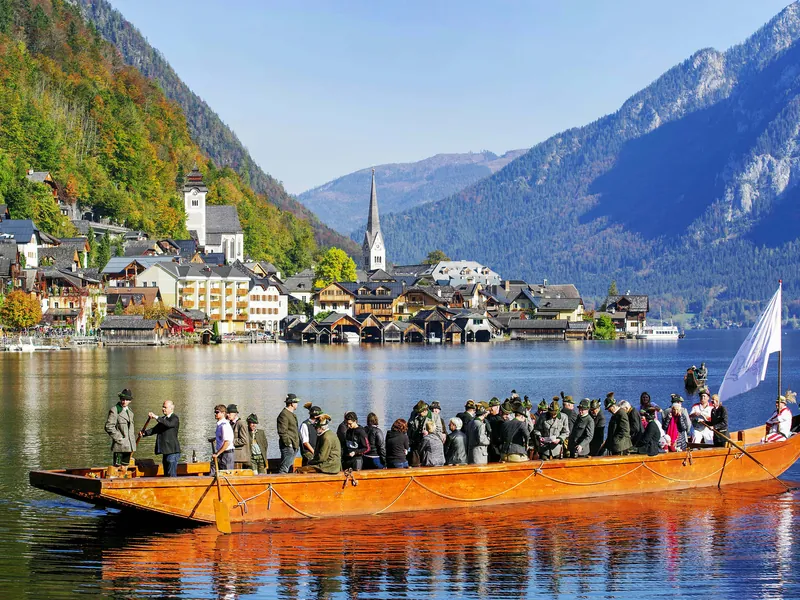
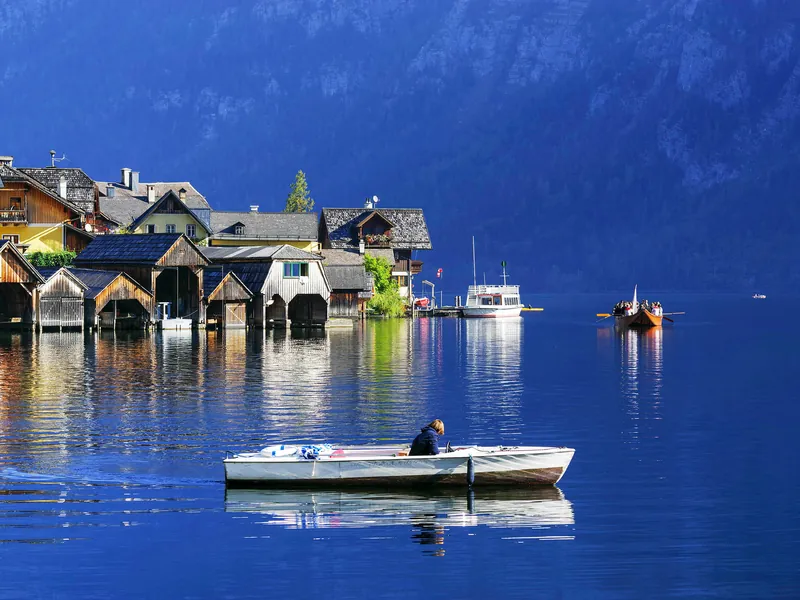
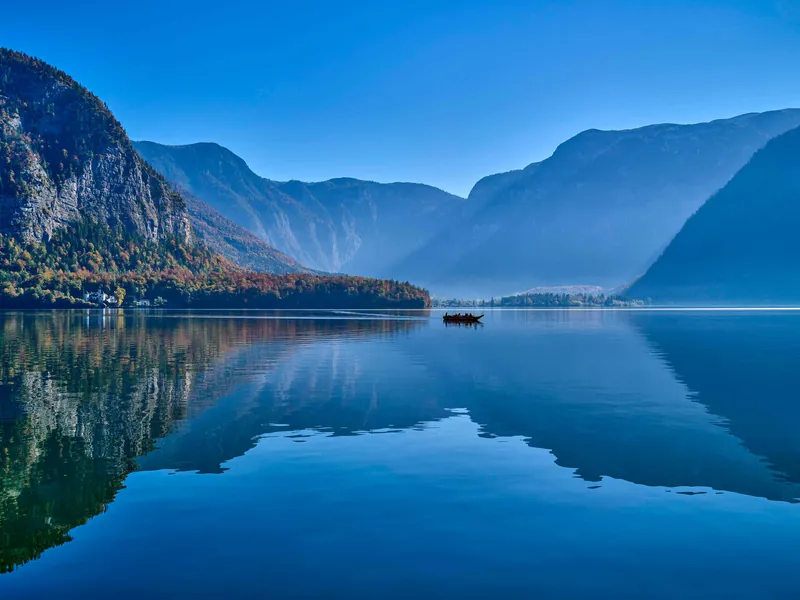
Ferries, an hour’s cruise, swans that arrived courtesy of an empress, and water that rarely climbs past 20 °C even in August.
One payment of €9.99. You get an activation email within a few minutes.
TouringBee for iPhone or Android. Download the audio over Wi-Fi before you leave your hotel.
Open the map, press play at stop 1, and walk. No group, no schedule, no roaming data.
Roughly 1.5 hours later, at the best viewpoint in the village. Then coffee, or the mine, or the trail along the brine pipeline.
Important for 2026: Salzwelten Hallstatt is closed while a new funicular is built. That means the salt mine, the Salzbergbahn and the Skywalk platform. Everything reopens on 29 August 2026. From then: mine tour with funicular €49, mine only if you walk up €33, funicular return without the mine €29. Open 9:30–16:30 until 24 October, reduced hours after that. Check salzwelten.at before you build a day around it.
Between about 16:30 and 09:30, Hallstatt belongs to roughly 750 people and whoever booked a bed. There are not many beds. A few dozen guesthouses in the village, more across the water in Obertraun — and they sell out months ahead for summer. If you want to experience the place rather than photograph it, this is the decision that does it.
Check places to stay in HallstattThe village walk is free and the audio guide is ours. Everything below is booked through partners — we earn a commission at no extra cost to you.
Most people reach Hallstatt from one of the two. TouringBee has a self-guided walk waiting in both.
The old town, the fortress view and the Mozart addresses, at your own speed — perfect for the evening before your Hallstatt day.
See the Salzburg tourThe Ringstrasse, the imperial addresses and the coffee houses, told properly. Useful for the days either side of the long trip out west.
See the Vienna tourDetailed guides are publishing through autumn 2026. These are the first out.
Train, car, bus or organised tour — times, costs and which one actually suits your day.
Coming soon →The hour-by-hour crowd pattern and the two windows that make the village feel like a village.
Coming soon →What the 2026 reopening changes, what the tour includes, and whether it is worth €49.
Coming soon →
Eugene is the founder of TouringBee, which builds self-guided audio walks for more than a hundred destinations. The Hallstatt route was written and walked on location, with professional historians and local sources. The practical information on this page is checked against the official operators — Salzwelten, the municipality of Hallstatt and the Hallstatt Museum. When they change it, we change it here.
Do the walking part with someone who can tell you what you are looking at. Seventeen stops, offline, at your own pace — from the ferry pier to the best view in the village.
Some links on this page are affiliate links. If you book through them we may earn a small commission, at no extra cost to you. It never changes what we recommend. Prices, opening dates and timetables were checked in August 2026 against the operators’ own websites — always confirm before you travel.