
Hallstatt from Salzburg: Best Ways to Get There
Seventy-five kilometres. Four completely different days, depending on how you cross them.
Salzburg to Hallstatt looks like a simple day trip. Seventy-five kilometres — but the ways of covering them are not equivalent. The train takes about two and a half hours and sets you down at a pier with the village in front of you across the water. The car takes an hour and a quarter but leaves you outside the historic centre, with a 15- to 40-minute walk in, depending on which car park still has space.
This guide covers the four options — train, bus via Bad Ischl, car, and an organised tour — with the numbers as they stand in autumn 2026, the ferry that most first-time visitors do not know they are about to take, and one date in December that will change every train time on this page.
One thing is easier to sort out at home than at the pier: you can walk the village end to end in fifteen minutes, but without some context it is easy to walk straight past most of its history. Our self-guided Hallstatt audio walk runs from the ferry pier to the World Heritage viewpoint in seventeen stops, offline, at whatever pace your train times allow. Download it on Salzburg wifi; you will not need a signal once you arrive.
Still planning the whole trip? Start with our complete guide to Hallstatt, then come back here for the getting-there details.
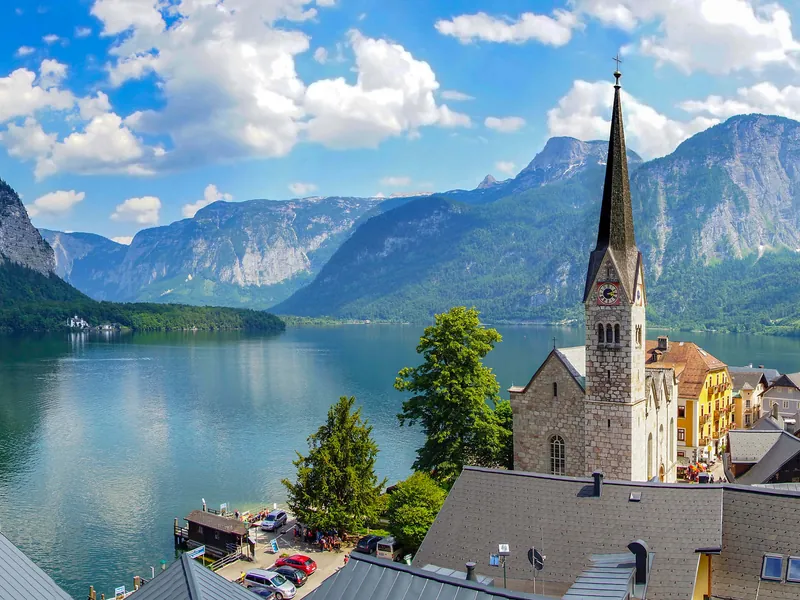
At a glance
| Option | Salzburg to Hallstatt, one way | What it costs | Suits |
|---|---|---|---|
| Train via Attnang-Puchheim | 2h20–2h50 — one change, plus a short ferry crossing at the end | ÖBB Sparschiene from €9.90; ferry €4.00 | Anyone without a car |
| Bus 150 + train via Bad Ischl | 2h30–3h — 1h20–1h30 to Bad Ischl, then the Salzkammergut train on | Two separate tickets — no combined fare | Very early starts; a stop in Bad Ischl |
| Car | 1h15–1h30 for 75–88 km, then a 15–40 min walk from the car park | Fuel + Austrian vignette + €10–20 parking | Groups of three or four with a car already |
| Organised day tour | 5.5–10 hours round trip, with 2–3 hours in the village | ≈€95–180 per person | Anyone who wants no logistics at all |
Segment lengths are indicative; the exact ranges are in the table above.
Choosing in twenty seconds
No car? Take the train. It is the most straightforward option, and the arrival across the water is part of the trip rather than a chore at the end of it.
Family or a group? Compare the car. For three or four people it is often competitive on price and noticeably faster — around an hour saved in each direction.
Want to decide nothing? Take a tour. It costs several times the train fare and puts you in the village in the middle of the day, but it removes every timetable, change and car park from your life.
By train
There is no direct train. You go Salzburg Hauptbahnhof to Attnang-Puchheim, then change onto the Salzkammergutbahn — the regional line that runs down the lakes through Bad Ischl to Hallstatt and on to Stainach-Irdning.
The two legs are very unequal, which is the thing most comparison tables get wrong. Salzburg to Attnang-Puchheim is quick: about 40 to 55 minutes. The Salzkammergut leg is the long one: roughly an hour and a half, with Bad Ischl about forty minutes in and Hallstatt another fifty or so beyond it. Add the change and the whole journey lands between 2h20 and 2h50.
The connection at Attnang-Puchheim can be a couple of minutes on some pairings. That is normal here and the trains are timed to hold — but it is not the moment to go looking for coffee.
Tickets
ÖBB's advance Sparschiene fares start at €9.90 in second class, bookable up to 180 days ahead, online or in the app only. They are tied to a specific train and are not refundable.
Travelling as two or more, look at the Einfach-Raus-Ticket: €38 for two people, €4 for each extra person up to five. One condition matters more than the price. It is valid only on regional trains — S-Bahn, R and REX — and not on Railjet, RJX or InterCity. The Salzburg to Attnang-Puchheim stretch is served by both kinds, so when you search for a connection you have to build it out of regional services only, rather than taking whatever ÖBB offers first.
The good news is that this costs you almost nothing in time: the regional trains cover that stretch in about the same 40 to 55 minutes as the fast ones. They just run less often — roughly every one to two hours rather than hourly. The second condition is the clock: on weekdays the Einfach-Raus-Ticket is only valid from 09:00, which rules out an early start anyway.
Walk-up fares change. Check oebb.at for your own date rather than trusting a figure in any article, this one included.
The ferry, and why the train is worth it
Hallstatt station is not in Hallstatt. It sits on the opposite shore of the lake — a small platform against the hillside with no village attached to it. You get off, walk down to a jetty, and a boat takes you across.
The boat is the Stefanie, run by Hallstätter Seeschifffahrt Hemetsberger. It is timed around the trains, it costs €4.00 one way and €8.00 return, and you pay at the quayside — it is not included in your rail ticket, whatever some sites tell you. The operator's own 2026 timetable gives the crossing as seven minutes; the Hallstatt tourist board says about fifteen. Either way it is short, and it is why the train earns its two and a half hours: the village arrives in front of you all at once, from the water, at the angle every photograph of it is taken from.
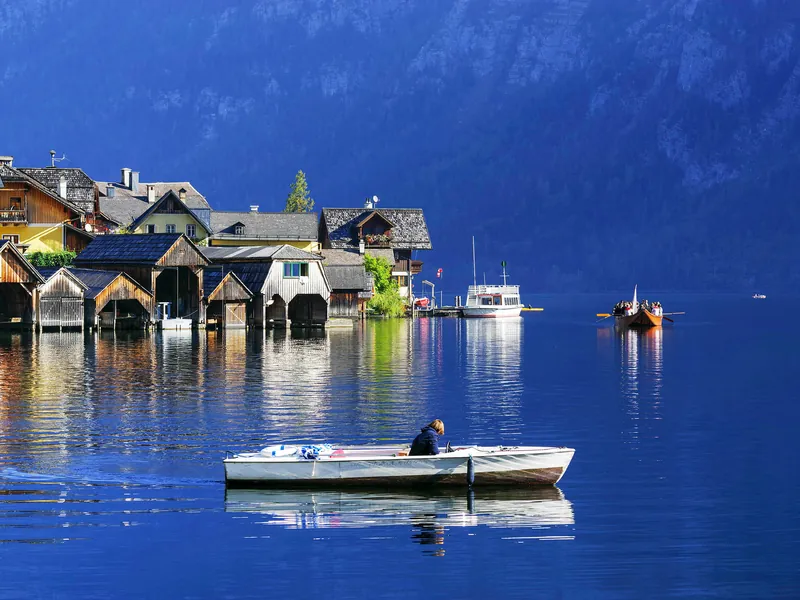
Two practical limits. On the timetable checked for autumn 2026, the last sailing from the village back to the station leaves at 18:30 — this changes by season, so confirm it for your own date. And the operator states plainly that onward connections are not guaranteed if a train runs late.
The line runs all year. The operator describes it as the only year-round scheduled ship service on an Austrian lake, which is a good thing to know in January.
By bus 150 via Bad Ischl
The alternative avoids Attnang-Puchheim altogether. Postbus line 150 leaves Salzburg Hauptbahnhof and Mirabellplatz, runs along the Wolfgangsee through Fuschl and St. Gilgen, and reaches Bad Ischl in about 1h20 to 1h30. From there you continue on the Salzkammergut train, or by regional bus with a change at Gosaumühle. All in, expect two and a half to three hours — so this is not the fast option, whatever the first leg suggests.
The bus runs roughly hourly, sometimes half-hourly, and you buy tickets from the driver, cash or card. There is no combined bus-plus-rail fare on this corridor that we could find; you buy the two legs separately.
The thing to check before you rely on it: the evening return. Buses onward from Bad Ischl toward Hallstatt, Obertraun and Gosau stop running early — the Hallstatt tourist board puts the last one at around 6 p.m. Whatever the current timetable says, build your way home around the train rather than the bus.
The route earns its place if you are starting very early, if the Wolfgangsee is part of what you came for, or if you are breaking the journey in Bad Ischl.
By car, and the parking problem
Two routes work. The one Hallstatt's own tourist board recommends runs south on the A10, off at Golling, then over the B166 through Abtenau and Gosau — about 77 km. The northern alternative goes through Mondsee and Bad Ischl on the B158, about 88 km. Both take roughly 1h15 to 1h30.
The official Hallstatt page puts the drive from Salzburg at around 45 minutes, which looks optimistic for planning purposes; navigation apps and the actual road usually give 1h15 to 1h30. Budget accordingly.
You need an Austrian vignette for the motorway section. You do not need a Tauern tunnel toll on this route — the A10 special toll section starts well south of the Golling exit, so it does not apply. If you are picking up a rental for the day, compare car hire in Salzburg before you commit to a tour price.
Parking
Visitor cars cannot enter the historic centre — two barriers see to it. You park in one of the numbered lots on the approach and walk in, and how far you walk depends on how early you arrived.
- P1 — just past the petrol station. About 20 minutes' walk to the centre, 10 to the salt mine.
- P2 — at the Salzbergbahn funicular. About 15 minutes to the centre, and one minute to the funicular, which reopened with a new cable car on 29 August 2026 after a year of works.
- P3 and P4 — the overflow. About 40 minutes' walk to the centre.
The 2026 tariff is the same at all of them: first 15 minutes free, then €5 for an hour, €9 for two, €10 for three to four, €12 for five to six, €15 for seven to twelve, and €20 for a full day. A lost ticket costs €40. Cash, Visa and Mastercard.
You cannot reserve a space. The operator publishes live free-space counts for each lot, updated every minute — the single most useful thing to open on your phone before the final descent into the valley. In high season P1 and P2 fill early, and the difference between arriving at 09:00 and at 11:30 may turn out to be the difference between a fifteen-minute walk and a forty-minute one.
By organised tour
Shared day tours from Salzburg run roughly €95 to €180 per person and last between five and a half and ten hours, depending on whether Hallstatt has the day to itself or shares it with the Sound of Music locations or the Alpine lakes. Private tours start around €265. Most are built the same way: transport there, a few hours of free time in the village, transport back.
What you buy is the removal of every decision in this article. What you give up is the clock — the free block usually falls in the middle of the day, when the village has the most day visitors in it.
Useful when comparing: coaches must pre-book an entry slot, and the exit slot has to be at least 2 hours 20 minutes after the entry slot — a rule designed to stop thirty-minute photo stops. So your free time has a floor, whatever the tour promises. Austrian press reporting, including ORF in December 2025, puts the cap at 54 coaches a day; the municipality's own pages do not state a figure, so treat the number as reported rather than official.
If you would rather assemble the day yourself, Hallstatt day trips and tickets are worth a look for the salt mine and Skywalk alone, which are easier to book ahead than to queue for.
Do you need a booking to enter Hallstatt?
No. As of September 2026 an independent traveller needs no ticket, permit, booking or entry fee to visit Hallstatt, and there is no time window when cars are turned away. Only coaches are regulated.
Restrictions are discussed — Austrian media have reported residents pressing for them, against roughly 1.2 million day visitors a year and only about 132,000 overnight stays, and have reported that the proposals ran into legal obstacles, since the access road is a provincial highway and a charge for entering public space is difficult to impose in Austria. Nothing of the sort is currently in force.
Important for travel in late 2026
13 December: the new rail timetable
Every train time currently published for this route is valid until 12 December 2026 and no further; the 2027 timetable is not out yet. The last change shifted many Salzkammergut departures by about an hour — the local authorities called it the Stundendrehung — so times copied from an older article are not merely stale, they can be wrong by a whole hour. Check oebb.at for your own date.
16 November: rail maintenance
ÖBB closes the Steeg-Gosau to Stainach-Irdning section on scattered Mondays, 08:00 to 16:00, and this is the last such date published for 2026. Hallstatt is inside that section. Replacement buses run instead — and here is the part worth knowing: the bus stops at Hallstatt Lahn (Seelände), in the village itself. On those Mondays you skip the ferry entirely and arrive on dry land, a few minutes from where the walk starts. ÖBB warns that ticket sales on the buses are limited, onward connections are not guaranteed, and bicycles are not carried.
When you get there
However you arrive, the walk is the same and it is short: the village is about a kilometre end to end. That is exactly why so many day visitors leave feeling they have seen a postcard rather than a place. Nothing in Hallstatt explains itself. The houses are stacked the way they are for a reason, the Ossuary is not a curiosity, and the finds from the burial ground above the village gave their name to an entire Iron Age culture.
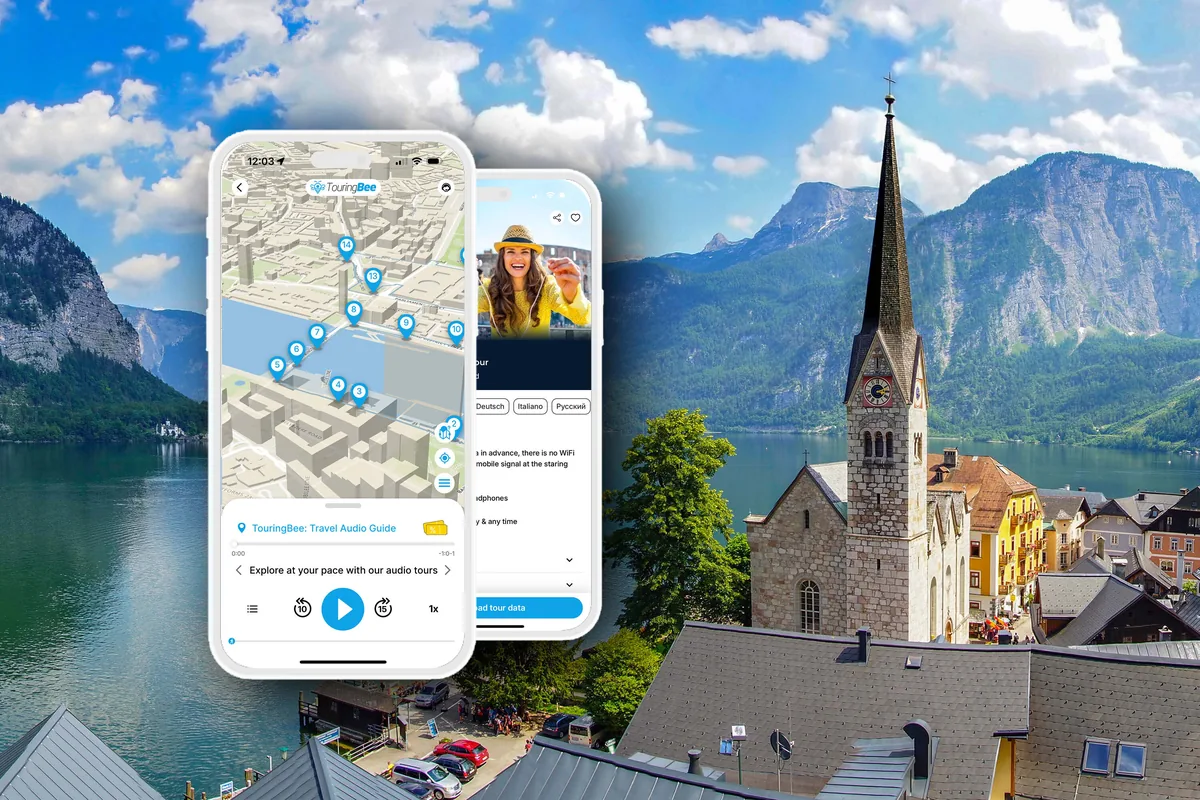
Our seventeen-stop Hallstatt Town Tour runs from the Lahn ferry pier to the World Heritage viewpoint and takes about an hour and a half at an unhurried pace. It works offline, so the train leg is a good moment to download it.

Hallstatt Town Tour — audio guide
- 17 recordings by a professional historian, written with humour
- Offline map with GPS navigation — no roaming needed
- Start any day, any hour; pause for lunch and pick it up later
- Illustrations so you know exactly what you’re looking at
- Works on iPhone and Android through the TouringBee app
Entry tickets to the Ossuary, salt mine and museum are not included.
For what to do with the hours between your two trains, go on to our complete independent day-trip itinerary from Salzburg.
Frequently asked questions
How long does it take to get from Salzburg to Hallstatt?
By train, 2h20 to 2h50 with one change at Attnang-Puchheim, plus a short ferry crossing. By car, 1h15 to 1h30 for 75–88 km, plus a 15–40 minute walk from the car park. By bus 150 via Bad Ischl, two and a half to three hours all in.
Is there a direct train from Salzburg to Hallstatt?
No. You change at Attnang-Puchheim onto the Salzkammergut railway. The first leg is about 40–55 minutes, the second about an hour and a half.
How much does the trip cost?
ÖBB Sparschiene fares start at €9.90 in second class if you book ahead and commit to a specific train. Two people travelling on regional trains only, after 09:00 on a weekday or any time at the weekend, can use the Einfach-Raus-Ticket at €38 for both. The ferry is €4.00 one way on top, paid at the pier.
Do you have to take a ferry to reach Hallstatt?
If you arrive by train, yes. The station is on the far shore and the boat is the only sensible way across. The exception is the rail maintenance Mondays, when the replacement bus drops you in the village instead.
Does the Hallstatt ferry run in winter?
Yes. The operator describes its line as the only year-round scheduled ship service on an Austrian lake. Sailings are fewer in winter, and the last one from the village is in the early evening, so confirm it for your date.
Is it worth driving to Hallstatt?
If there are three or four of you and you already have a car, often yes — the drive is considerably faster than the train. Factor in parking and a 15- to 40-minute walk. Renting a car specifically for the day is a different calculation; compare it against the train fare for your group.
Can you visit Hallstatt as a day trip from Salzburg?
Comfortably. A few hours is enough for the village itself; if you are adding the salt mine, the Skywalk or a walk in the surrounding valley, set aside most of the day. Our independent day-trip itinerary sets out how.
Continue exploring
So, which one?
If you are travelling without a car, the train remains the simplest option, and the last minutes across the lake become part of the journey rather than the end of it. If you already have a car and there are several of you, it saves over an hour in each direction — just check the live parking counts before you drop into the valley. A tour costs considerably more, but it takes the timetables, the changes and the car park off your hands.
Whichever you choose, the village at the other end takes fifteen minutes to cross and about seven thousand years to explain. Sort out that part before you leave Salzburg.
Prices, timetables and rules on this page were checked in September 2026 against the operators' own sites — ÖBB, Salzburger Verkehrsverbund, Hallstätter Seeschifffahrt and the Hallstatt parking operator. The Austrian rail timetable changes on 13 December 2026; confirm your own train times before you travel. Some links on this page are affiliate links. If you book through them we may earn a small commission, at no extra cost to you. It never changes what we recommend.